On this page
What do tree sap and bird droppings do to clear coat?
They eat into it. Both are acidic, and heat speeds the reaction, so a drop that lands on a warm hood can leave a dull ring within days. Wiping it off dry adds scratches on top. What remains is a small crater in the clear coat: shallow ones polish out, deep ones can only be softened.
Longwood is a town with a famous tree story: Big Tree Park lost The Senator, a 3,500-year-old cypress, to a fire in 2012, and its companion Lady Liberty, about 2,000 years old, still stands. Any car parked beneath branches collects droppings and sap daily.
How does he know how much paint can be polished away?
He measures before he polishes. A paint depth gauge reads the thickness of the paint on each panel, and a test spot shows how the defects respond to a given pad and polish. Clear coat is thin, so the aim is to remove only as much as the damage needs, keeping enough for years of washing ahead.
Where an etch goes deeper than is safe to chase, he will level it as far as he can and tell you plainly what is left.
Which correction level fits sap and dropping damage?
Light, scattered marks usually respond to a single-stage gloss revival. Etching across the roof and hood, together with wash swirls, normally needs the two-stage enhancement, a cutting step followed by a finishing polish. A neglected finish with heavy etching and haze is a multi-stage restoration.
The main paint correction page explains each level, and the Longwood area guide covers the trees and the drive.
How do I stop new etching after a correction?
Give the paint a barrier and clean it quickly. A sealant or, better, a ceramic coating sits between the clear coat and whatever lands on it, so sap and droppings bond to the protection first. Keep a soft microfibre in the car for spot cleaning, and park away from flowering trees when you can.
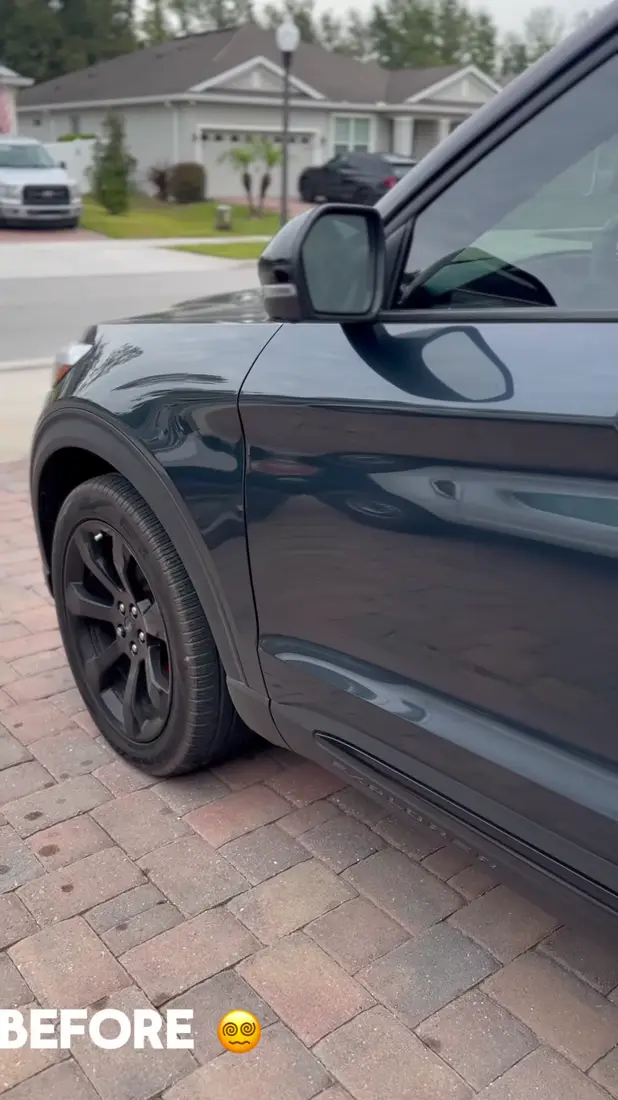
Dull paint before enhancement · his own job
Terms on this page: paint depth gauge · tree sap · bird droppings · multi-stage correction (in the detailing glossary).