On this page
- Wait for the first wash until your installer says so. One coating maker's rule: no water for 24 hours, no chemicals for 7 days. [1]
- Use a pure, pH-neutral car shampoo with no wax or polymer add-ins, never dish soap. [1] [2] [3]
- In Florida, wash in the shade and dry fast: minerals in the water dry into spots. [5]
- Brush car washes wear a coating down faster. If you must use one, pick touchless.
When can you wash a new ceramic coating for the first time?
Wait until your installer says the coating has cured. Nick heat-cures his coatings on site and tells you on the day how long to keep the car dry and when the first wash is safe. As a general guide, one coating maker advises keeping the car dry for about 24 hours and avoiding wash chemicals for about a week.
A fresh coating is still hardening. Coating maker IGL says to keep the car dry for at least 24 hours and avoid wash chemicals for at least 7 days. [1] A 2026 Jalopnik guide says 24 hours before water and multiple days before a car wash. [4] Cure times differ by coating, so the instructions you get on the day come first. OCD uses infrared curing to speed it up.
What do you need to wash a coated car?
You need two buckets, ideally with grit guards, a pH-neutral car shampoo, a clean microfiber wash mitt, a separate mitt or brush for the wheels, two or three soft microfiber drying towels and a hose. A foam cannon is a nice extra. Everything should be clean before it touches the paint.
- Grit guards sit in the bottom of the buckets, so rinsed-off grit stays below the mitt. [3]
- Microfiber towels should be washed on their own, without fabric softener, which clogs the fibres.
- A foam cannon lets you do a snow foam pre-wash that softens dirt before the mitt touches the paint.
How do you wash a ceramic-coated car, step by step?
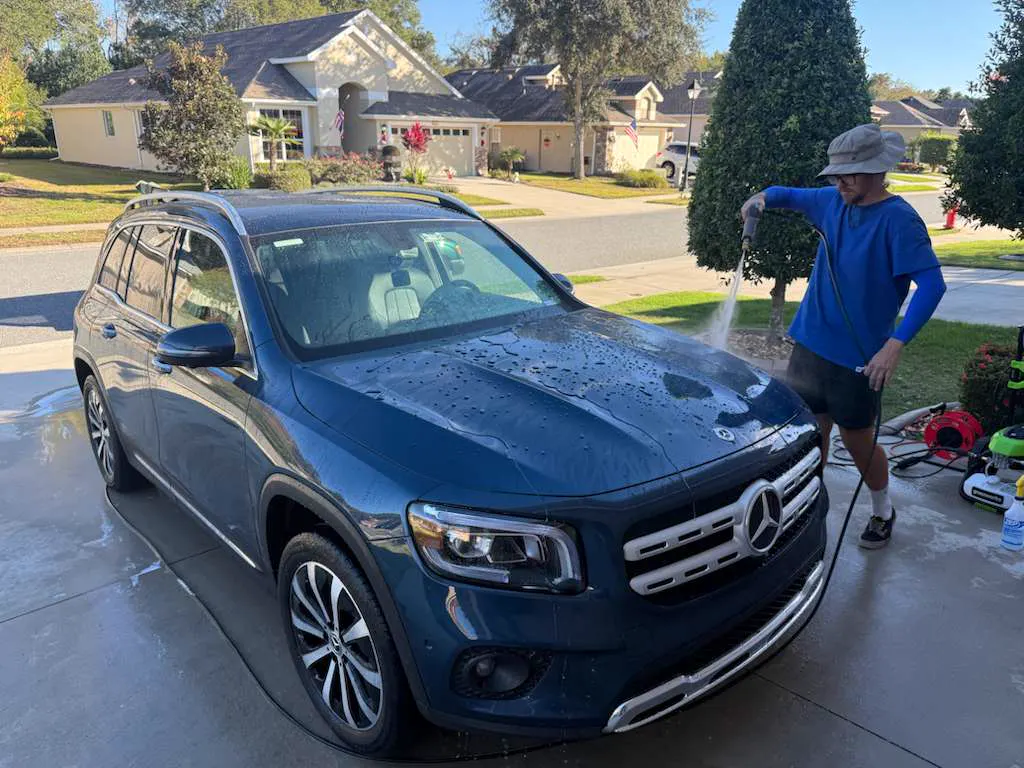
Work in the shade on cool paint. Rinse the whole car first, then wash one panel at a time from the top down with a soapy mitt, rinsing the mitt in the plain bucket before every reload. Rinse again, then dry straight away with microfiber. The whole wash takes about 45 minutes.
- Pick the time and place.Shade, early morning or evening, with paint cool to the touch.
- Rinse the whole cartop to bottom, to knock off loose sand and grit before anything touches the paint.
- Optional: snow foam.Let it sit a few minutes to soften dirt and pollen, then rinse it off with the loose grit in it.
- Fill the buckets.One with shampoo and water, one with plain water.
- Wash top down, one panel at a timein straight lines, dirtiest lower panels last. Wheels get their own mitt.
- Rinse the mitt in the plain bucketbefore it goes back in the soap. The grit stays there, not on your paint. This is the two-bucket method. [1] [3]
- Rinse the car againtop to bottom.
- Dry straight awaywith a soft microfiber towel, blotting rather than dragging. [3]
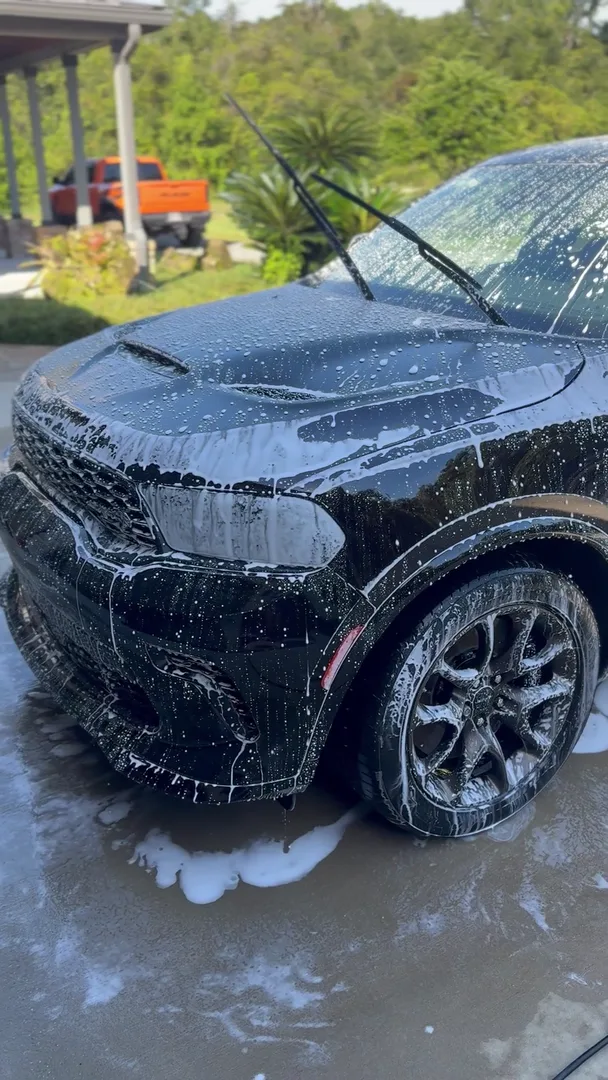 Real job · Durango SRT · foam stage
What soap should you use on a ceramic coating?
Use a pH-neutral car shampoo, ideally one with no wax, polymers or gloss enhancers in it. A pure shampoo lifts dirt without leaving a film on top of the coating. Do not use dish soap or strong degreasers: they can dull protection, ceramic coating included, and dry out rubber trim.
A pH-neutral shampoo is neither acidic nor alkaline, so it cleans without stripping protection. IGL advises pH-neutral car soap without waxes in it. [1] Gtechniq, another coating maker, recommends avoiding shampoos with added polymers and using a pure shampoo. [2] A wash-and-wax soap puts wax over your coating, so water meets the wax instead.
Use a car-wash soap, not dish soap or another detergent that can strip protection from your paint. [3]
Can you take a ceramic-coated car through an automatic car wash?
Avoid it when you can. Brush and cloth tunnel washes can drag grit from earlier cars across your paint and wear a coating down faster. If you need a car wash, pick a touchless one, then dry the car with a clean microfiber towel so spots do not bake on in the sun.
Brushes in an automatic car wash may carry grit from earlier vehicles [3], and IGL lists automated washes as too harsh on a coating. [1] Touchless washes avoid contact but use strong chemicals that can wear protection faster, so ask whether the wash uses pH-neutral soap. [4] Either is still better than leaving lovebugs to bake on.
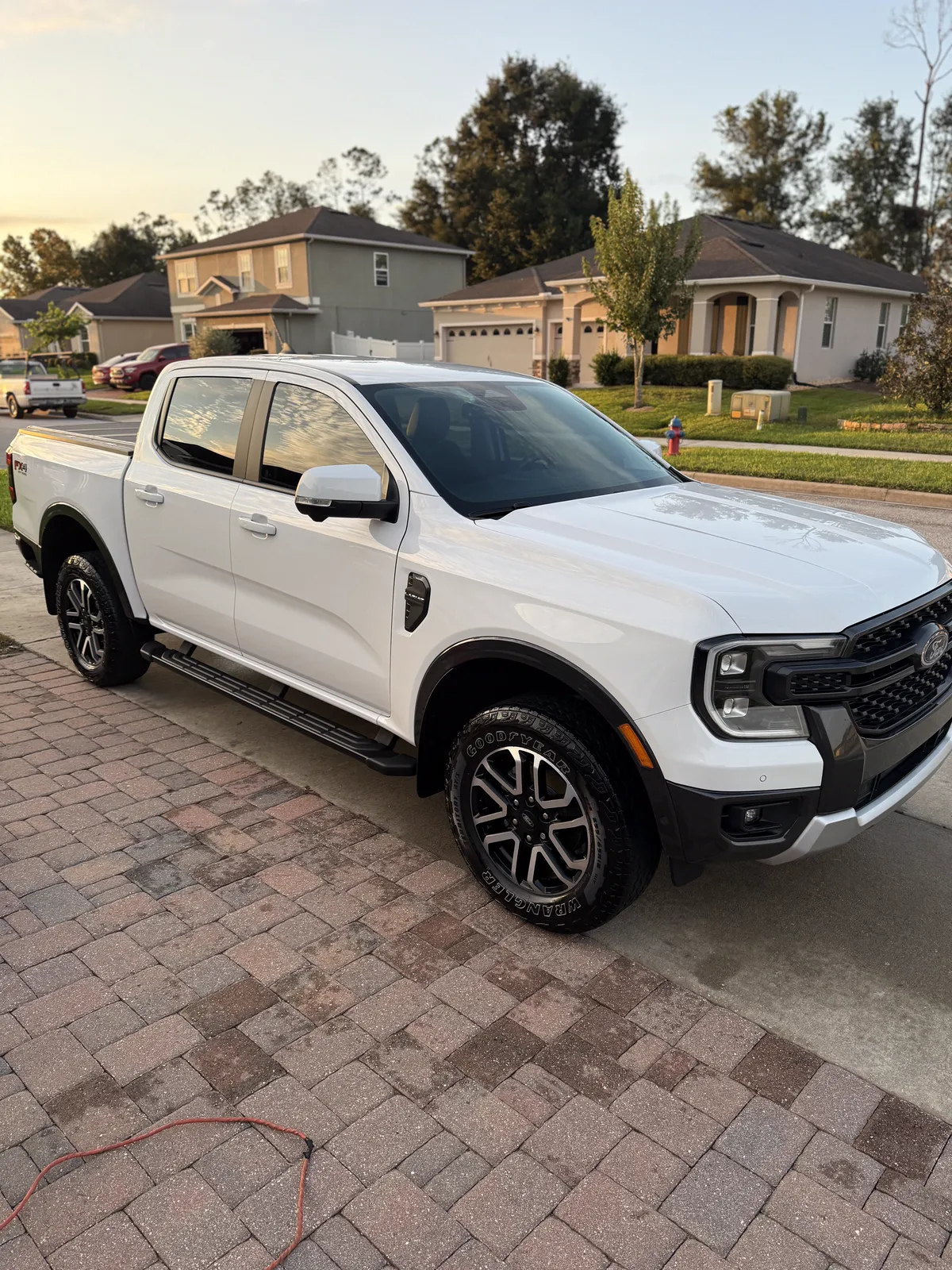 Real job · Ford Ranger · after the detail
See what is included on the ceramic coating in Apopka page.
How do the Florida sun and hard water affect washing?
Florida sun dries soap and water on the paint before you can rinse, which leaves spots and streaks. Florida water carries minerals, so drops that dry on the car leave them behind as water spots. Wash in the shade on cool paint, keep each panel wet, and dry the car straight away.
Sun. Washing in direct sun dries soap on the panel, and hot paint makes chemicals act harder. IGL advises against washing in direct heat and sun. [1] On jobs, Nick works under his own mobile canopy.
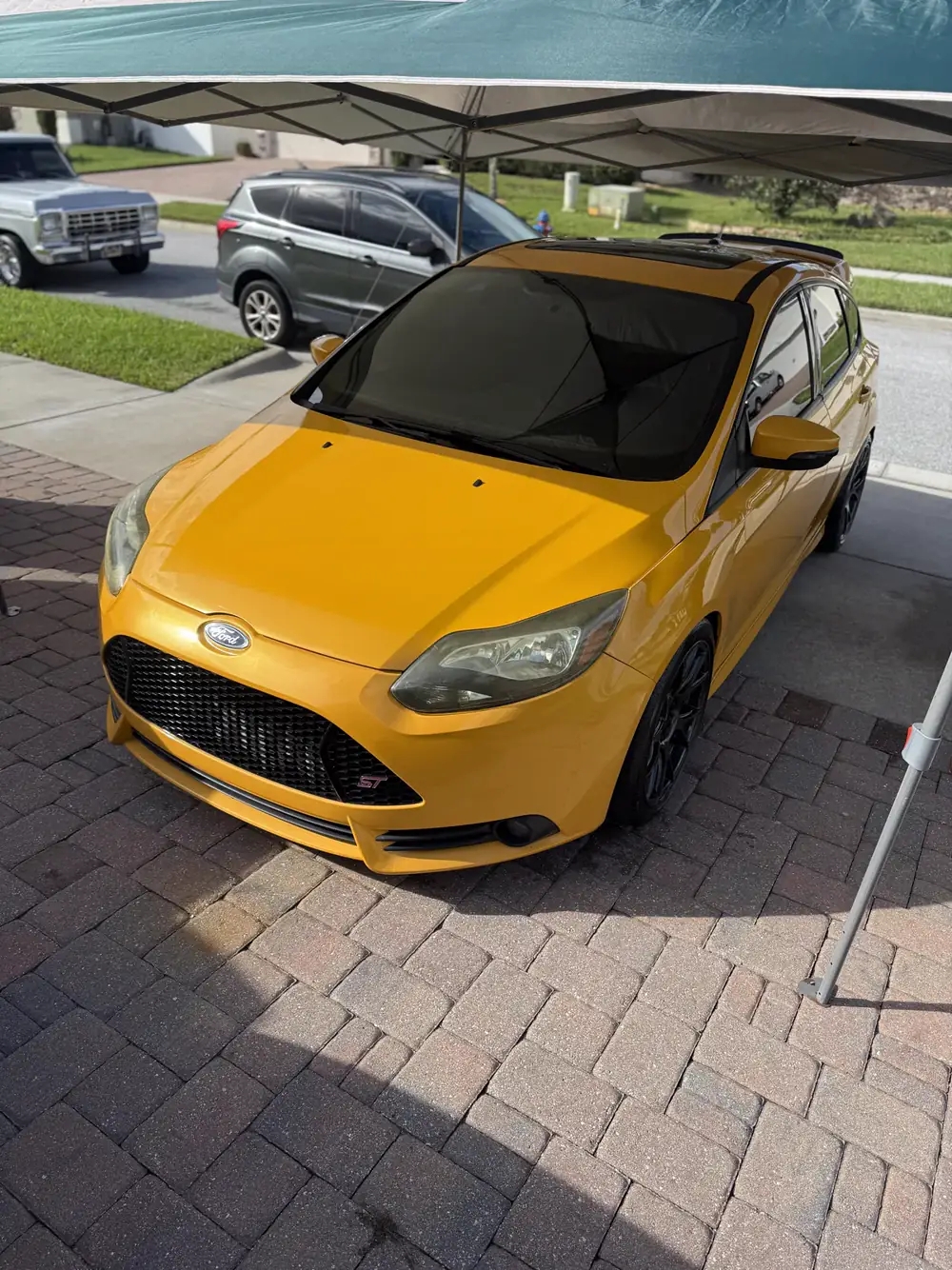 Real job · Focus ST · under the canopy
Hard water. The USGS calls water hard at 121 to 180 mg/L, and very hard beyond that. In the northwest and much of central Florida, the Floridan aquifer is under 180 ppm hardness; elsewhere in the state it runs harder. [5] Well water and sprinklers are common culprits; the Central Florida car care guide has a checklist to stop spots. The minerals stay behind as water spots, which can etch if left in the sun. Rain is no help: it picks up grime and pollen and dries into spots too. Park out of sprinkler range.
How often should you wash a ceramic-coated car?
About every two weeks for a daily driver, and sooner whenever it is dirty. IGL's advice is a light wash or waterless wash every two weeks or whenever the car is dirty. [1] In Florida, wash more often in pollen season and during the May and September lovebug flights.
Some things should not wait for wash day:
- Lovebugs. UF/IFAS advises washing them off within a day to limit paint damage. [6] On a coated car they release with a normal wash.
- Bird droppings. Lift them off soon with a quick-detailer spray, pressing rather than scrubbing.
- Pollen and sap. Florida trees often release pollen from January to June. [7] Rinse the film off before rain and heat bake it on.
Do you need a topper on a ceramic coating?
Not every wash, but a topper every few months keeps a coating slick and the beading strong. A ceramic topper is a quick ceramic spray or light coat that goes over an existing coating. Use one when water stops beading as tightly. Do not use wax: a topper is made to go over a coating.
Why not wax? It wears off in weeks in Florida heat. Ceramic coating vs wax compares the two.
IGL suggests a ceramic coating booster every few months [1], and Gtechniq says its Quick Detailer can be layered to boost gloss, slickness and durability. [2] To tell when, mist the hood after a wash: tight round beads mean healthy, flat clinging sheets mean fading. The 2-minute coating health test shows what to look for.
When a topper is not enough, OCD's Level 1 single-stage polish, Essential Gloss Revival, is built for maintaining ceramic coatings.
What should you never do to a ceramic-coated car?
Never use dish soap or strong degreasers, never take it through a brush car wash, and never wash it on hot paint in full sun. Do not wipe a dusty car with a dry towel, do not use a dropped or dirty towel, and do not leave bugs or droppings on it for days.
- Dry-wiping dust or sand drags grit across the paint. A waterless wash suits only a lightly dusty car.
- Dirty or dropped towels are a common cause of fresh swirl marks.
- Compounds or abrasive pads belong to a pro, when the coating needs a polish.
Questions people ask
Can I use Dawn dish soap on a ceramic-coated car?
Not as your wash soap. Dish soap is made to cut grease, and dish soap and strong degreasers can dull protection, ceramic coating included, and dry out rubber trim. Harsh soaps are one of the things that push a coating to the short end of its life. Use a pH-neutral car shampoo instead.
Do I need to dry a ceramic-coated car?
Yes. A coating makes water bead and roll off, but the drops that stay behind still dry into mineral spots, and Florida water carries minerals. Dry the car straight away with a soft microfiber towel, top down, and swap to a fresh towel when the first one gets heavy.
Can I use a waterless wash on a coated car?
Only when the car is lightly dusty. A waterless spray lifts light dust so it can be wiped off with microfiber. On a car covered in sand, mud or lovebugs it risks scratching, because the grit is dragged across the paint. For anything more than dust, do a proper rinse and hand wash.
Can I put wax on a ceramic-coated car?
You can, but there is little reason to. Wax wears off in weeks in Florida heat, and while it is on, water meets the wax instead of the coating. A ceramic topper, not wax, is made to go over a coating. See ceramic coating vs wax for how the two compare.
Want it done for you?
Nick comes to your driveway or office in Apopka and 19 nearby towns, 8 AM to 8 PM every day, with his own water, power and canopy. Pick your vehicle and package in the booking app and see the price before you confirm. See ceramic coating in Apopka, the car detailing packages, or call (407) 462-6623.
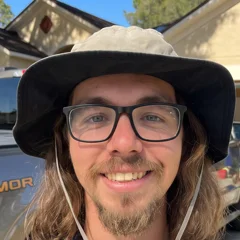
Nick founded Obsessively Clean Detailing in Apopka and does every detail himself, at the customer’s home or office. The Obsessively Clean Detailing details here come from his own packages and booking app; general figures are from the sources below. More about Nick.
- IGL Coatings (ceramic coating maker), “Just got a Ceramic Coating Done and you’re not sure how to maintain it?”, Apr 25, 2022. blog.iglcoatings.com/how-to-maintain-ceramic-coatings
- Gtechniq (ceramic coating maker), “Caring for your Gtechniq coating”. www.gtechniq.co.uk/maintain-your-coating
- Cars.com, Joe Bruzek, “The Best Way to Wash Your Car”, Sept 24, 2018. www.cars.com/articles/the-best-way-to-wash-your-car-1420695111006
- Jalopnik, B. L. Johnson, “Ceramic Coating Vs. Waxing: The Pros, Cons, And Differences Explained”, Feb 21, 2026. www.jalopnik.com/2104138/ceramic-coating-vs-waxing-pros-cons-differences
- U.S. Geological Survey, “Hardness of Water”; University of South Florida, Exploring Florida, “Water Hardness” (from the USGS map of the Floridan aquifer). www.usgs.gov/special-topics/water-science-school/science/hardness-water · fcit.usf.edu/florida/docs/w/waterhard.htm
- University of Florida IFAS, “Fact or Fiction? The Truth About Those Pesky Lovebugs”. blogs.ifas.ufl.edu/news/2004/05/27/fact-or-fiction-the-truth-about-those-pesky-lovebugs
- University of Florida IFAS Gardening Solutions, “Pollen and Allergies”. gardeningsolutions.ifas.ufl.edu/design/outdoor-living/pollen-and-allergies